
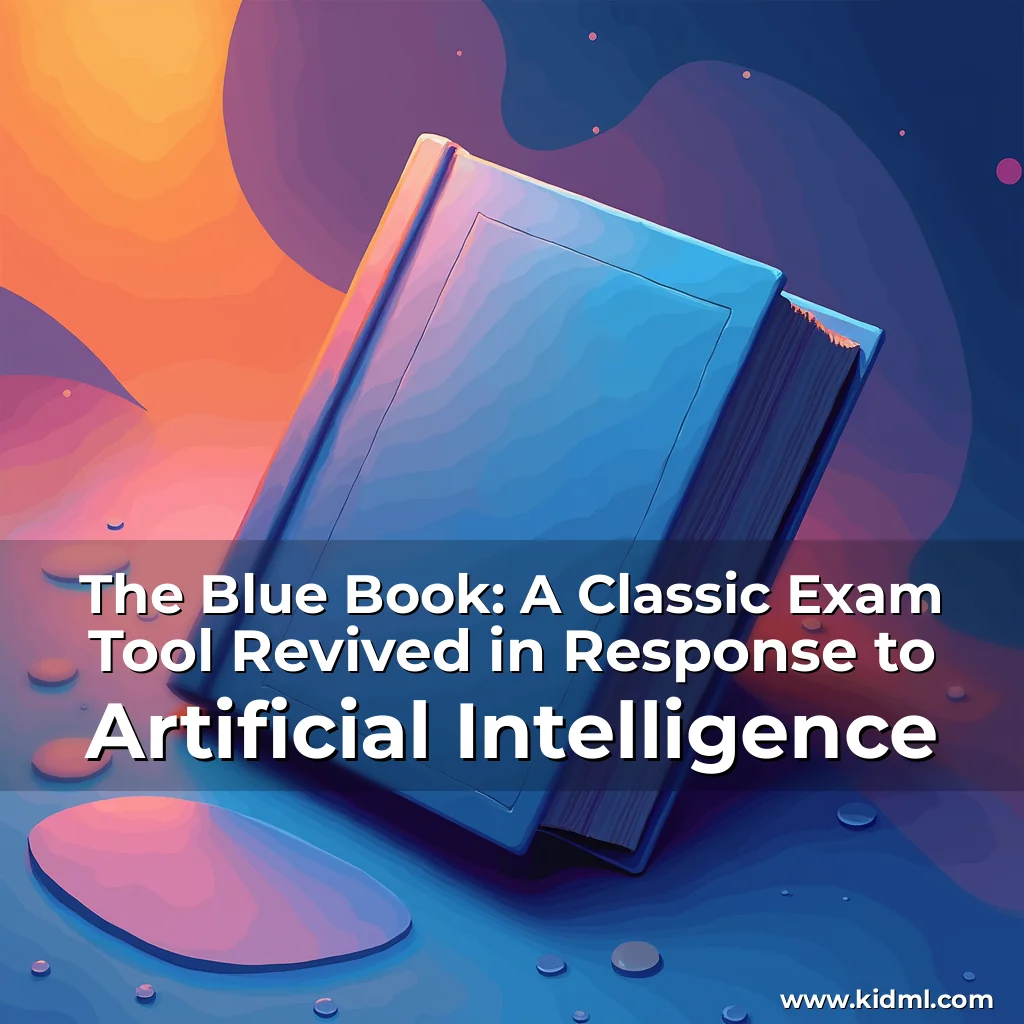
In a world where artificial intelligence (AI) is increasingly prevalent, a classic exam tool from the past is getting a second chance – the blue book. Father Patrick Flanagan, a professor at St. John’s University, is reviving the blue book as a way to help students develop critical thinking skills in the face of AI-generated essay answers. The blue book, a blue-covered booklet filled with blank but lined pages, was a staple in exams for decades. Students would write their essay answers by hand, using a pen, not a keyboard. This hands-on approach was seen as essential in developing critical thinking skills, as students had to organize their thoughts and articulate their ideas in a clear and concise manner. Father Flanagan, who chairs St. John’s Department of Theology and Religious Studies, believes that the blue book is the only way to get students to contemplate an organization of thought and then produce a reasonable essay. He argues that the use of AI to generate essay answers robs students of the opportunity to develop these essential skills. “I think it’s a way to get kids to think critically, to organize their thoughts, and to express themselves in a way that’s not just regurgitating information from a computer program,” Father Flanagan said. The use of AI in education has become a growing concern, with many institutions exploring ways to address the moral and ethical implications of this technology. Schools are also looking at how to integrate AI into their curricula in a way that promotes critical thinking and creativity. Some institutions are taking a proactive approach, offering degree programs in AI and cybersecurity. For example, the Catholic University of America in Washington has introduced new bachelor’s and master’s degree programs in artificial intelligence, with specialized tracks in AI in healthcare, robotics, and ethical AI design. Others, like Fordham University, are exploring the thorniest issues of the field, including privacy and responsibility in fields such as artificial intelligence, data science, and cybersecurity. The Catholic Church is also weighing in on the issue, with Pope Francis issuing a note that warned about the possibility of AI creating more cost-effective solutions for tasks such as financial accounting, thus eliminating high-paying jobs and relegating “deskilled” people to manual labor. Pope Francis also declared a “grave ethical concern” of potential AI-controlled military weapons systems like drones that could operate without human control. The new pope, Pope Leo XIV, has also spoken out on AI, calling it “an exceptional product of human genius,” but still a tool, not to be confused with human intelligence. He emphasized the need to safeguard “the inviolable dignity of each human person and respecting the cultural and spiritual riches and diversity of the world’s peoples.”
The development of AI requires steps to address these concerns, and schools are exploring ways to integrate AI into their curricula in a way that promotes critical thinking and creativity. Some institutions are joining forces with other institutions and private industry to share research and explore the safe and moral use of this rapidly growing technology. For example, St. John’s University has joined the AI Alliance (founded by IBM and Meta) and the AAC&U Institute on AI, Pedagogy, and the Curriculum. The common good is at the heart of this effort, with institutions like St. Francis College in Brooklyn exploring new undergraduate and graduate offerings in AI. The college’s vice president of academic affairs for graduate education, Gale Gibson-Gayle, said the program explores AI methods that address real-world threats with “technical expertise and ethical responsibility.”
She also described SFC’s partnership with Cornell University, offering certificates in AI for healthcare and cybersecurity. John Edwards, vice president of academic affairs for undergraduates, also said the college is exploring new undergraduate and graduate offerings in AI. “Our goal is to position SFC as a leader in ethically grounded, forward-looking AI education,” Edwards said. Tim Cecere, SFC’s president, said these programs are based on the Franciscan principles of “integrity, compassion, and purpose.”
“At St. Francis College, we view technology as a profound gift from God to man,” Cecere said. “It is the extension of human creativity and intellect meant to serve the common good.”
- The blue book is a blue-covered booklet filled with blank but lined pages, used by students to write their essay answers by hand.
- Father Flanagan believes that the blue book is the only way to get students to contemplate an organization of thought and then produce a reasonable essay.
- The use of AI to generate essay answers robs students of the opportunity to develop critical thinking skills.
- Schools are exploring ways to address the moral and ethical implications of AI in their curricula.
- Institutions are offering degree programs in AI and cybersecurity, with specialized tracks in AI in healthcare, robotics, and ethical AI design.
| **Institutions Offering AI Programs** | **Programs Offered** |
| Catholic University of America | Bachelor’s and master’s degree programs in artificial intelligence, with specialized tracks in AI in healthcare, robotics, and ethical AI design. |
| Fordham University | Doctoral program to explore multiple facets of artificial intelligence, including privacy and responsibility in fields such as artificial intelligence, data science, and cybersecurity. |
| St. John’s University | Joining the AI Alliance (founded by IBM and Meta) and the AAC&U Institute on AI, Pedagogy, and the Curriculum. |
| St. Francis College | Master’s degree program in Cybersecurity and Critical Infrastructure Protection, with certificates in AI for healthcare and cybersecurity. |
“Technology is a profound gift from God to man, and it is the extension of human creativity and intellect meant to serve the common good.” – Tim Cecere, SFC’s president
As AI continues to evolve, it is essential that institutions prioritize the development of critical thinking and creativity in their students.
St.

news is a contributor at KidML. We are committed to providing well-researched, accurate, and valuable content to our readers.
You May Also Like


About news
Passionate about making AI and machine learning accessible to everyone, especially young learners and beginners.
Related Articles

Embracing Artificial Intelligence in Indian Education: A Transformative Force
As the world grapples with the complexities of the fourth industrial revolution, India finds itself…
Read More →
Armenia AI leap : how open access and strategic alliances could supercharge a small country high tech future
The Rise of AI in Armenia Armenia has been actively embracing AI, recognizing its transformative…
Read More →
Exploring AI Education: Komdigi Partners with University of Tokyo
The Ministry of Communication and Digital (Komdigi) is taking a significant step towards enhancing digital…
Read More →