
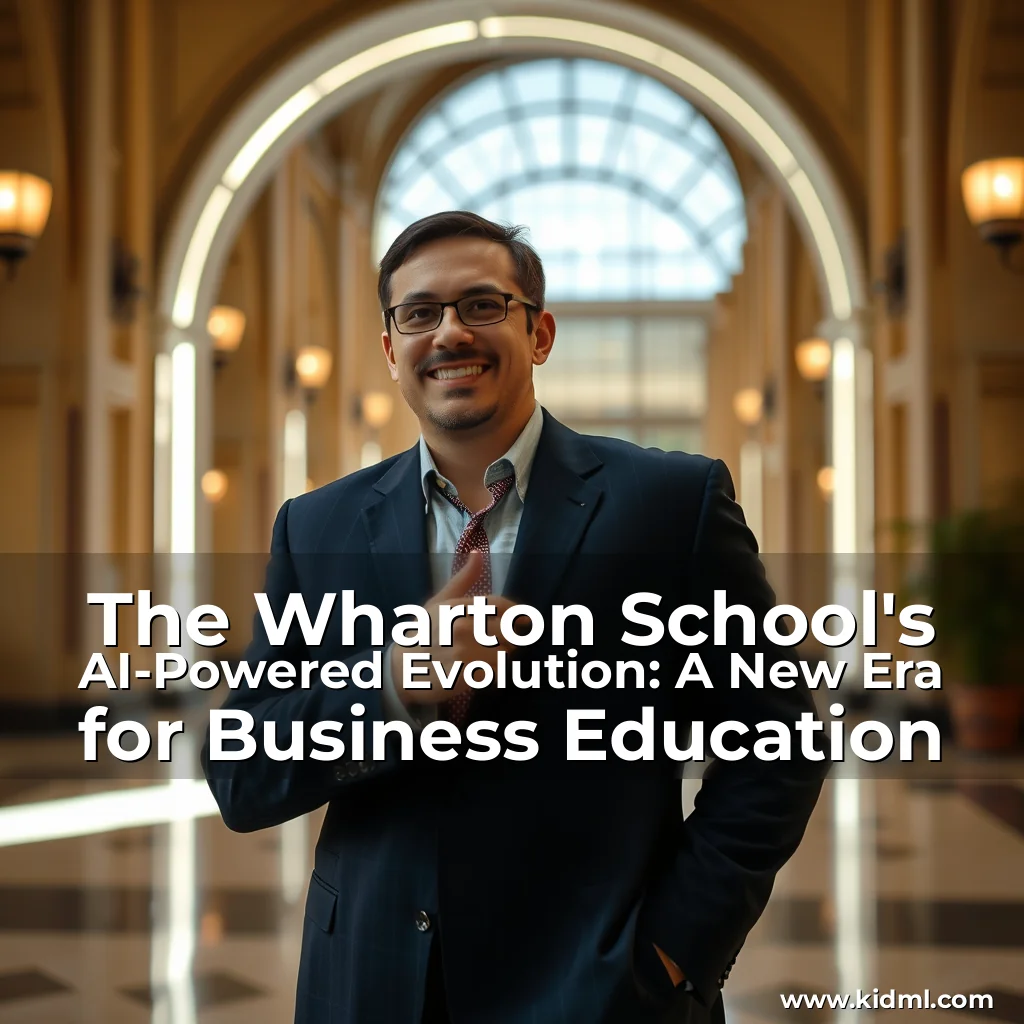
Embracing the AI-Powered Future: Wharton School’s Evolution
The Wharton School, one of the most prestigious business schools in the world, is evolving to meet the changing demands of the AI-powered world. In a move that signals the school’s commitment to preparing students for the future, Wharton has unveiled a new MBA major and undergraduate concentration in artificial intelligence.
A New Curriculum for the AI-Powered World
The new curriculum will provide students with a comprehensive understanding of how businesses are using AI, as well as the economic, social, and ethical implications of this technology. The program will be divided into three main areas:
• Technical Foundations of AI: This area will focus on the technical aspects of AI, including machine learning and deep learning. • Economic, Social, and Ethical Implications of AI: This area will explore the broader implications of AI on business, including its impact on employment, regulation, and ethics. • Applications and Future Directions: This area will examine the various applications of AI in business, including data mining, marketing, and neuroscience.
Required Courses and Electives
Some of the required courses include:
• “Big Data, Big Responsibilities: Toward Accountable Artificial Intelligence”: This ethics class will focus on the responsible use of AI, emphasizing the importance of accountability and transparency. • “Foundations of Deep Learning”: This course will introduce students to the technical foundations of AI, covering topics such as neural networks, generative AI, and efficient deep learning.
Wharton’s AI-Powered Future
The introduction of AI-powered courses is just the beginning. Wharton has also updated the syllabi for existing classes, including the management course “Innovation, Change, and Entrepreneurship” and the marketing course “Introduction to Brain Science for Business.”
Preparing Students for the AI-Powered World
According to Wharton Vice Dean Eric Bradlow, “We are at a critical turning point where practical AI knowledge is urgently needed.” He emphasized that companies are struggling to recruit talent with the necessary AI skills, and students are eager to deepen their understanding of the subject and gain hands-on experience.
The Impact of AI on Business
Wharton faculty began discussing a new AI curriculum last year, and the school has since launched the AI and Analytics Initiative to study possible changes to its curriculum, invest in new research, and collaborate with industries. The initiative has also led to the creation of the AI Research Fund and the Education Innovation Fund to support faculty research and adoption of AI in the classroom.
AI-Powered Careers
The introduction of the AI-powered curriculum is expected to produce graduates who will be adept in four key areas:
• Technical Knowledge of AI: Students will have a strong technical understanding of AI, enabling them to assess the design and application of AI models in a business setting. • Business Impact Analysis: Students will be able to analyze the impact of AI on business operations and make informed decisions. • Ethics and Governance: Students will understand the ethics of data and automated decision-making, as well as the legal frameworks governing AI. • Adaptability and Flexibility: Students will be equipped to adapt to new AI developments and navigate the rapidly changing landscape of AI-powered business.
A Jack-of-All-AI-Trades
According to Wharton Professor Giles Hooker, “We expect the impact of AI on business to be long and deep. Even without new breakthroughs in human-like reasoning, we can expect AI methods to penetrate even further into business processes and our lives.” Hooker emphasizes that the careers and job titles associated with AI’s penetration into business have not yet been fixed, and graduates of Wharton’s new program may emerge as jack-of-all-AI-trades, capable of adapting to a variety of AI-powered roles.
The Future of Business Education
The introduction of AI-powered courses at Wharton marks a significant shift in the field of business education. As the world becomes increasingly dependent on AI, the need for practical AI knowledge has never been more urgent. Wharton’s evolution is a testament to the school’s commitment to preparing students for the future, and its new AI-powered curriculum is a step towards creating a new generation of AI leaders.
Conclusion
As Wharton School embarks on this exciting new journey, it is clear that the future of business education is AI-powered. With its comprehensive curriculum, updated syllabi, and emphasis on practical AI knowledge, Wharton is well-positioned to equip students with the skills and expertise needed to thrive in the AI-powered world. The school’s evolution is a beacon of hope for a brighter future, where business education is tailored to the needs of the rapidly changing world.

news is a contributor at KidML. We are committed to providing well-researched, accurate, and valuable content to our readers.
You May Also Like


About news
Passionate about making AI and machine learning accessible to everyone, especially young learners and beginners.
Related Articles

Class Is in Session: How some law schools are training students in generative AI
Legal Education As law schools continue to adapt to the rapidly evolving landscape of artificial…
Read More →
CSUF conference teaches faculty how to adapt to artificial intelligence
Understanding the Impact of AI on Education The integration of artificial intelligence in education has…
Read More →
Invasion of privacy : Youths more distrustful of AI data systems B C study finds
Understanding the Perceived Risks and Benefits of Artificial Intelligence The study aimed to explore how…
Read More →